

The main SendGrid alternatives are Resend, Postmark, Mailgun, Brevo and Mailtrap, each a standalone email API. SendGrid's free option is a 60-day trial at 100 emails a day. Deploying to Codata IO instead? Codata Email sends auth, transactional and batch email from your domain, such as one workspace update to every member. No separate vendor account needed.
There are two ways to replace SendGrid. One is another standalone email API. The other is email built into the platform your app already runs on.
This page compares both on what engineers check first: API or SMTP, DNS authentication, dedicated IPs, webhooks, log retention and pricing model. Codata IO is the cloud for agentic coding, and it covers the second path. Vendor facts link to each vendor's page, checked 4 Nov 2026.
SendGrid alternatives at a glance
SendGrid alternatives split into standalone email APIs and email built into a cloud. Every standalone option below offers both an API and SMTP.
| Tool | Type | Free option | Dedicated IP | Log history |
|---|---|---|---|---|
| SendGrid | Email API | 60-day trial, 100 emails a day | 1 included on Pro and Premier | 3 days, 7 on Pro |
| Resend | Email API | 3,000 emails a month, 100 a day | $30 a month add-on on Scale | 30 days |
| Postmark | Transactional email API | 100 emails a month | Add-on from $50 a month, Pro and up | 45 days on paid plans |
| Mailgun | Email API with inbound parsing | 100 emails a day | 1 included from Foundation 100k | 1 to 30 days by plan |
| Brevo | Marketing plus transactional | Up to 300 emails a day | Not stated per plan | Not stated |
| Mailtrap | Test sandbox plus sending | 4,000 emails a month, 150 a day | Business plan and up | 3 days, up to 30 |
| Codata Email | Email inside the cloud | 100 emails a day on Free | Not listed | Activity log of every send |
Sources: SendGrid pricing, SendGrid SMTP docs, Resend pricing, Resend SMTP docs, Postmark pricing, Postmark SMTP, Mailgun pricing, Mailgun, Brevo pricing, Mailtrap pricing, checked 4 Nov 2026. Codata Email from the 2 Nov 2026 product review.

Why engineers look for a SendGrid alternative
Engineers look for a SendGrid alternative when its lower tiers stop fitting production needs. The common triggers are the trial, short search history, few webhooks and gated dedicated IPs.
- No permanent free tier. The free option runs 60 days, so staging and side projects need a paid plan after that.
- Three days of searchable activity. The trial and Essentials keep 3 days. Debugging last week's missing reset email needs Pro or a paid history add-on.
- Event webhooks are counted. The trial includes 1 event webhook, Essentials 2 and Pro 5.
- Dedicated IPs start on Pro. Essentials lists none; Pro includes one, with more as an add-on.
- DNS work per domain. Domain authentication generates four records by default: CNAMEs for SPF, DKIM and link branding, plus a DMARC TXT record.
None of this makes SendGrid wrong for a large sender. It does make the entry tiers a weak fit for a small production app.
SendGrid pricing and cost in 2026
SendGrid pricing is a starting price per plan: Essentials from $19.95 a month, Pro from $89.95 a month, and Premier on quote. The final price depends on monthly volume, and overage charges may apply.
| Option | Free option | Entry paid plan | Next plan up | Overage |
|---|---|---|---|---|
| SendGrid | 60-day trial | Essentials, from $19.95 a month | Pro, from $89.95 a month | "May apply" |
| Resend | 3,000 emails a month | Pro, $20 for 50,000 emails | Scale, $90 for 100,000 emails | $0.90 per 1,000 |
| Postmark | 100 emails a month | Basic, $15 for 10,000 emails | Pro, $16.50 for 10,000 emails | $1.80 per 1,000 on Basic, $1.30 on Pro |
Sources: SendGrid pricing, Resend pricing, Postmark pricing, checked 4 Nov 2026.
SendGrid cost is hard to model from that page alone. Resend and Postmark publish volume and overage per tier, so you can price a known monthly send count directly.
Price the extras too. A dedicated IP, longer log history and more webhooks often move you up a tier before volume does. Postmark's Pro and Platform tiers cost more per month but less per extra email.
How to evaluate an email API
Judge an email API on six criteria, in this order. Volume pricing matters, but authentication and observability decide whether production email works.
- API and SMTP. An HTTP API returns structured errors your code can act on. SMTP suits frameworks and tools that only speak SMTP.
- SPF, DKIM and DMARC. Check who creates and maintains the records. Some tools generate them for you; others leave the DNS work to you.
- Dedicated or shared IPs. A dedicated IP isolates your reputation but needs steady volume to warm, so vendors gate it by plan or volume.
- Event webhooks. You need bounce and complaint events to suppress bad addresses. Count the endpoints each plan allows.
- Log retention. Across the tools above it runs from 1 to 45 days. Short retention turns support tickets into guesswork.
- Pricing model and vendor count. Compare per-plan and per-volume pricing at your real send count. Then count accounts: each email API adds a key, a dashboard and a bill.
A free email API plan is for testing. Check whether its limit is daily, monthly or a trial before you rely on it in production.
The best SendGrid alternatives
Each option below covers what it is, where it fits and one limit. Prices come from each vendor's pricing page on 4 Nov 2026.
Resend
Resend is an email API built around a clean HTTP interface, with SMTP as a second route. It fits teams that want a simple SDK plus newsletters through its Broadcasts feature.
The Free plan includes one webhook endpoint, three custom domains and every webhook event type. Pro allows 5 endpoints and Scale 10. One limit: Free stops at 100 emails a day, which leaves little room for a launch-day spike.
Already on Resend and want a Resend alternative? Postmark is the closest match for transactional email. If your app's backend runs on Codata, you may not need either.
Postmark
Postmark is an email service built for transactional email, sent by API or SMTP. It fits apps where receipts and password resets are the email that matters.
The free Developer plan sends 100 emails a month and, in Postmark's words, never expires. Event webhooks are listed on every plan. Broadcast message streams keep newsletters apart from transactional mail. One limit: a dedicated IP needs Pro or higher and 300,000 emails a month.
Mailgun
Mailgun is an email API and SMTP service for sending, receiving and tracking email. It fits high-volume senders and apps that parse inbound messages.
The free plan sends 100 emails a day from one custom domain, with tracking, analytics and webhooks. Foundation and Scale start with a free month, then cost $35 and $90 a month. Extra dedicated IPs cost $59 a month each. One limit: logs last 1 day on Free and Basic, 5 on Foundation and 30 on Scale.
Brevo
Brevo is a marketing platform that also sends transactional email by API and SMTP. It fits teams that want newsletters, campaigns and app email in one account.
The free plan is free forever and sends up to 300 emails a day. Brevo states that all plans include its transactional APIs, SMTP and outbound webhooks. Its Starter plan begins at 5,000 emails a month. One limit: the free plan needs account approval before it sends, and the marketing suite may be more than an app needs.
Mailtrap
Mailtrap is an email platform with two parts: an Email Sandbox that catches test email and an Email API and SMTP service for sending. It fits teams that test templates before real inboxes see them. Paid Sandbox plans add more test emails and sandboxes.
The free sending plan sends 4,000 emails a month, 150 a day, and its webhooks report opens, clicks, bounces and spam. Paid sending starts at $15 a month for 10,000 emails. One limit: logs last 3 days on Free, and a dedicated IP starts on the Business plan.
Codata IO: email without a SendGrid or Resend account
Codata Email is the email service inside the Codata cloud, alongside hosting, data, sign-in and AI. It fits apps whose backend runs on Codata, wherever the frontend is hosted.
It sends auth email such as confirmation and reset, transactional email to one recipient and batch email to many, from your domain. Templates come in Markdown or MJML with a live preview.
Batch email is one app event sent to everyone it concerns. For example when someone updates a shared project, every workspace member gets their own copy of "Maria updated the Q4 plan". It is still transactional: the product triggers it, not a campaign. Newsletters and promotions are marketing email and need opt-in.
Deliverability checks run on each template, and an activity log records every send. Your agent sends by event over the REST API. Notification email is a module in the backend plan your agent proposes, so you review it before anything deploys.
One limit: Codata is not an SMTP relay or a marketing tool, and it sends only for apps whose backend runs on Codata. The Free plan's sending limit is 100 emails a day.
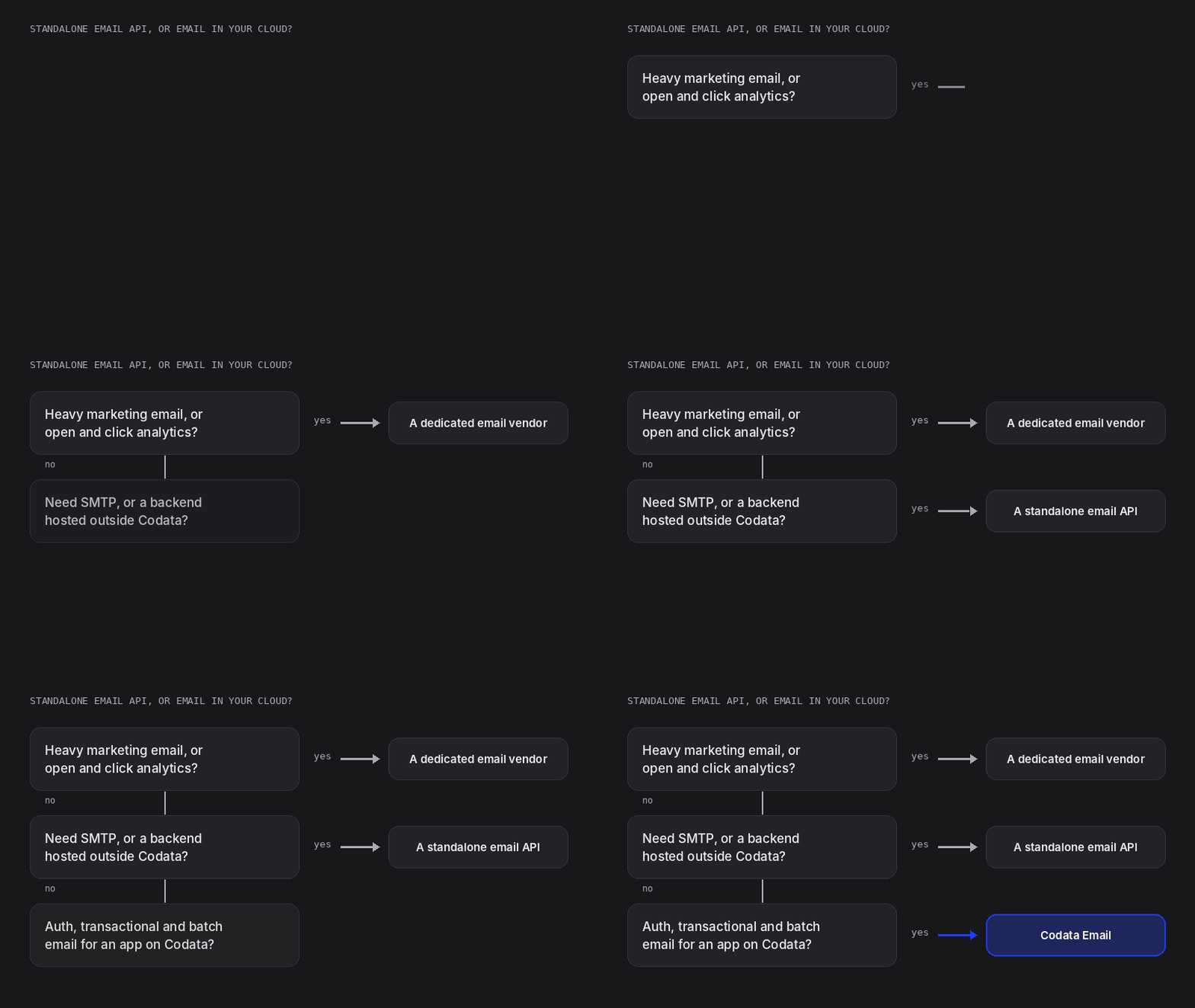
Standalone email API or email in your cloud?
Choose a standalone email API when email is a product in its own right. Choose email built into your cloud when it is plumbing for an app your agent deploys.
A dedicated email vendor is the better choice for:
- Heavy marketing email, campaigns and list management.
- Open and click analytics, or long log retention.
- A dedicated IP for a high, steady send volume.
- SMTP from legacy systems, or apps whose backend runs elsewhere.
Codata Email fits when the app already runs on Codata. There is no SendGrid or Resend account, API key or SMTP credential to manage. Codata wires DNS for domains it runs, and its chat walks you through DKIM for domains you bring. Sending pauses automatically if bounces pass 5% or complaints pass 0.1%.
That is the point of one cloud: email sits on the same meter as hosting, data, sign-in and AI. The stack it replaces is a host, a database, an auth vendor and an email API. See how it compares on the database side in our Supabase alternatives guide.
Lovable app? Keep your hosting and run the rest on Codata. For how app email works end to end, read how transactional email works in web apps.
FAQ
What is the best alternative to SendGrid?
It depends on the job. Resend fits a clean developer API, Postmark fits transactional email, Mailgun fits volume and inbound parsing, and Brevo fits email plus marketing. Mailtrap adds a test sandbox. If your app's backend runs on Codata IO, Codata Email covers auth, transactional and batch email without another vendor.
Is there a free SendGrid alternative?
Yes. Resend's free plan sends 3,000 emails a month, Mailgun's 100 a day and Brevo's up to 300 a day. Postmark's sends 100 a month, and Mailtrap's 4,000 a month. Codata IO includes email on its Free plan, with a sending limit of 100 emails a day.
Why is SendGrid so expensive?
SendGrid prices by plan and monthly volume. After a 60-day free trial, Essentials starts at $19.95 a month and Pro at $89.95. A dedicated IP, 7 days of activity search and more event webhooks come with Pro. Sending past a plan's volume may add overage charges.
Do I need an email API for my app?
Not always. If the app sends only auth, transactional and batch email and its backend runs on a cloud with email built in, that covers it. You need a standalone email API for heavy marketing email, deep engagement analytics, SMTP or a backend hosted elsewhere.
Can I send emails from my app without SendGrid?
Yes. You can use another email API, such as Resend, Postmark or Mailgun. Or, if your agent deploys the app to Codata IO, Codata Email sends from your own domain with no email vendor account. Our transactional email guide explains how app email works end to end.